
Deep forecast evidence file
Which London postcodes will see the biggest housing demand surge in the next 6–12 months?
Forecasting methodology reviewed by Oxford AI
This page documents how we identified the London postcode districts poised for the biggest surge in housing demand over the next 6–12 months: the question we asked, the research process, the district-by-district evidence, and every source used.
The forecast
The three London postcode districts most likely to post the biggest near-term surge in housing demand, ranked by the strength and timing of their employer and infrastructure catalysts against local supply.
E14Canary Wharf / Isle of Dogs
Visa’s 300,000 sq ft HQ lease, JPMorgan’s planned 3M sq ft tower and Revolut’s new office — just as the residential pipeline is set to switch off after 2026
N1CKing’s Cross
Google’s £1B Platform 37 HQ opening late 2026 with ~4,000 employees, while the King’s Cross Central masterplan’s housing is largely tapped out
NW2Brent Cross / Cricklewood
Brent Cross West’s 12-minute rail link and Sheffield Hallam’s 2026 campus arrival, with the next wave of homes not landing until mid-2027
The common thread: immediate catalysts — blue-chip employer moves and transformative infrastructure — colliding with residential pipelines that are tightening or lagging exactly when the workforce arrives.
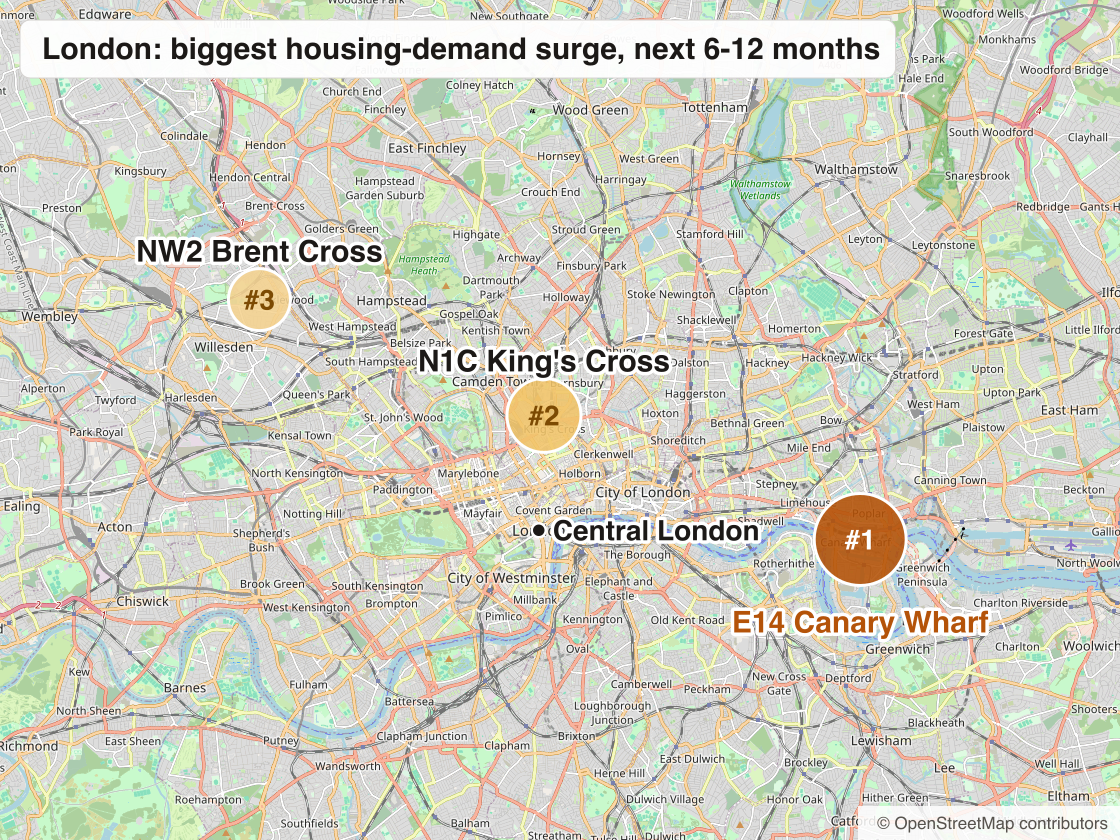
The same forecast on the map: marker size is the rank of each district's expected housing-demand surge, with the favourite in dark gold.
The exact question we asked
Question
Which London postcode districts are poised for the biggest surge in housing demand over the next 6–12 months?
What we weighed
Signed corporate leases and HQ openings with disclosed headcounts and dates, transformative transit (Elizabeth line, Brent Cross West), and each district's residential delivery pipeline — what is complete, what is coming, and when it lands.
How the forecast was made
This forecast is built bottom-up from confirmed, dated catalysts rather than from price momentum. The process weighs three forces per district:
- Demand shock. Signed leases, HQ openings and institutional arrivals with disclosed headcounts landing in or near the 6–12 month window.
- Access.New or transformed transit that widens each district's commuter catchment.
- Supply response. Masterplan delivery phasing — what is already complete, what opens next, and the gaps in between — the constraint that determines whether a demand shock translates into a genuine surge.
London's strongest setups are districts where employment density peaks in the exact window when the local residential pipeline pauses.
District-by-district evidence
E14Canary Wharf / Isle of Dogs — Blue-chip recommitments meet a pipeline about to switch off
Demand is being driven by a cluster of major corporate recommitments and relocations: Revolut opened its new office in September 2025, Visa signed a 15-year lease for a 300,000 sq ft European headquarters at One Canada Square (moving in 2028), and JPMorgan announced plans for a new 3 million sq ft tower. The district’s accessibility has been fundamentally transformed by the Elizabeth line, driving its evolution into a mixed-use neighbourhood. But housing supply is expected to tighten significantly: while the Wood Wharf development is delivering around 3,600 new homes, industry sources warn the residential construction pipeline will “basically turn off” after 2026 — leaving limited new inventory to absorb the incoming corporate workforce.
N1CKing’s Cross — Employment density peaking just as on-site housing taps out
The late-2026 opening of Google’s £1 billion “Platform 37” headquarters is a massive demand catalyst: designed to house roughly 4,000 employees, the campus consolidates Google’s London workforce next to the unmatched King’s Cross/St Pancras transit interchange. Unlike emerging regeneration zones, the 67-acre King’s Cross Central masterplan — roughly 2,000 new homes across 50 buildings — is already nearing completion. Because on-site residential supply is largely tapped out just as employment density peaks, housing demand and pricing pressure in N1C and its immediate commuter-feed zones are expected to surge over the next year.
NW2Brent Cross / Cricklewood — A maturing regeneration story with a clear supply gap window
This rapidly maturing regeneration area is anchored by the new Brent Cross West station, which provides 12-minute rail access to central London. Institutional migration is driving near-term demand: Sheffield Hallam University’s London campus is preparing to welcome students in the 2026 academic year, part of a wider masterplan projected to deliver 25,000 jobs and 3 million sq ft of office space. Although phase-one residential buildings are complete and house over 1,000 residents, the next wave of major supply — including Plot 15 rental and affordable homes — will not begin phased openings until mid-2027. That leaves a clear 6-to-12-month window where infrastructure- and education-driven demand will outpace fully delivered housing inventory.
What could change this forecast
Key uncertainties
- Corporate move-in dates can slip — Visa's 2028 move and JPMorgan's tower are longer-dated, so E14's near-term surge rests on the momentum they signal rather than desks filled this year.
- Google's late-2026 opening could shift; a delay would push N1C's peak employment density beyond the forecast window.
- Regeneration phasing can accelerate — earlier-than-planned Brent Cross Town deliveries would narrow NW2's supply-gap window.
This page is for informational purposes only and is not investment, financial, or real estate advice. Conclusions are estimates based on the sources cited and are not guarantees of any outcome.
Preparing your access…