Deep forecast evidence file
Which Austin ZIP codes will see the biggest housing demand surge in the next 6–12 months?
Forecasting methodology reviewed by Oxford AI
This page documents how we identified the Austin-area ZIP codes poised for the biggest surge in housing demand over the next 6–12 months: the question we asked, the research process, the ZIP-by-ZIP evidence, and every source used.
The forecast
The three Austin-area ZIP codes most likely to post the biggest near-term surge in housing demand, ranked by the strength and timing of their employer and infrastructure catalysts against local supply.
76574Taylor / Williamson County
Samsung’s $17B semiconductor fab opening late 2026 into a severely constrained housing market
78617Del Valle / Southeast Austin
Southwest Airlines’ new crew base plus Tesla’s $717M Gigafactory expansion along SH-130 / Highway 71
78729North Austin / Parmer Lane / Tech Corridor
Apple’s Capstone Phase Two campus delivering for 5,000 employees against thin local supply
These submarkets combine concrete, near-term hiring timelines with varying degrees of housing supply pressure — from Taylor’s severe constraint to Del Valle’s fast-but-still-tight pipeline.
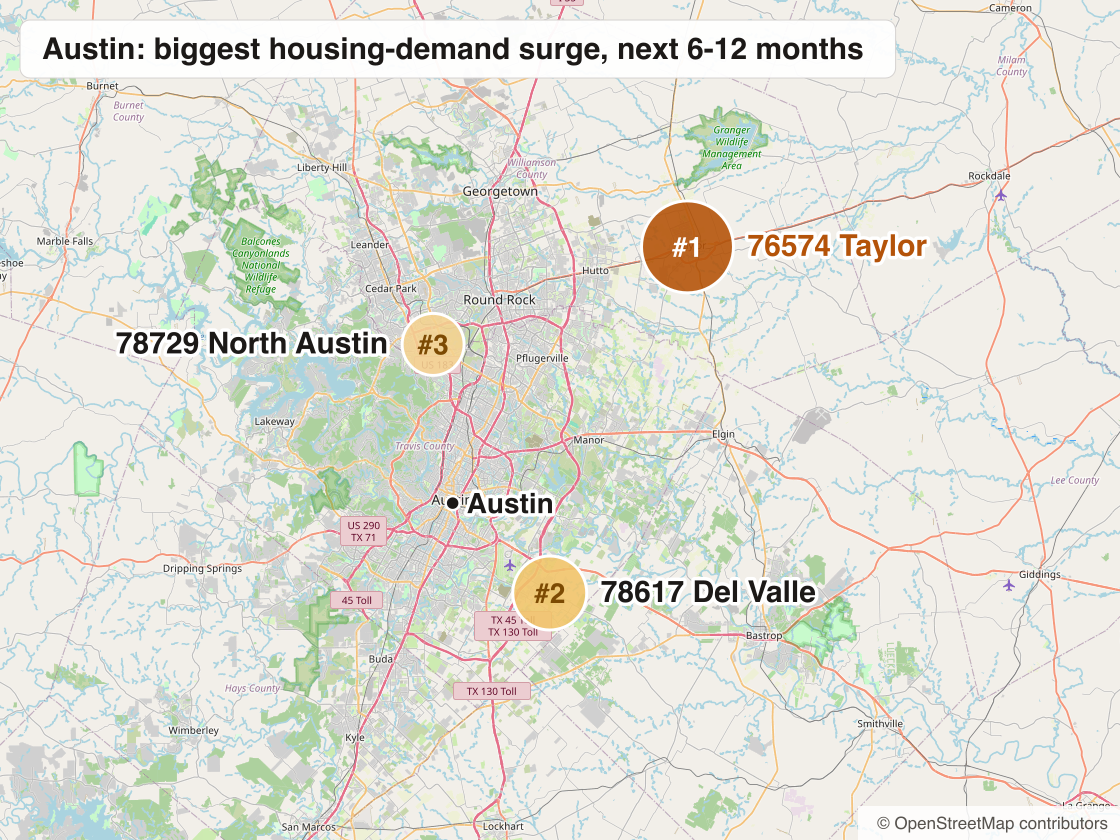
The same forecast on the map: marker size is the rank of each ZIP's expected housing-demand surge, with the favorite in dark gold.
The exact question we asked
Question
Which Austin-area ZIP codes are poised for the biggest surge in housing demand over the next 6–12 months?
What we weighed
Scheduled employer expansions with disclosed headcounts and dates, infrastructure catalysts, and regional supply constraints — approved multifamily projects, units under construction versus absorption, and pipeline delivery timing.
How the forecast was made
This forecast is built bottom-up from confirmed, dated catalysts rather than from price momentum. The process weighs three forces per ZIP:
- Demand shock. Scheduled employer openings and expansions with disclosed headcounts and delivery dates landing in the 6–12 month window.
- Access. The corridors and campuses that anchor each submarket’s commuter catchment.
- Supply response. Approved projects, units under construction versus recent absorption, and pipeline delivery timing — the constraint that determines whether a demand shock translates into a genuine surge.
The strongest setups pair an acute, precisely-timed employer shock with a supply base that cannot respond inside the window.
ZIP-by-ZIP evidence
76574Taylor / Williamson County — The strongest candidate for a severe supply-demand mismatch
Samsung’s $17 billion advanced semiconductor fab is scheduled to begin operations in late 2026, bringing roughly 1,800 direct jobs and thousands of indirect roles. Additional 2025–2026 manufacturing relocations to Taylor include Compal and Melagen Labs. Despite this massive workforce influx, housing in 76574 is severely constrained: only four multifamily projects are currently approved for construction amid a deficit of thousands of workforce units, with roughly 6,000 residential units stuck in the planning pipeline as developers struggle to finance them.
78617Del Valle / Southeast Austin — Aerospace, industrial and automotive hiring along SH-130 / Highway 71
Southwest Airlines is opening a new crew base at Austin-Bergstrom International Airport in March 2026, launching with roughly 1,000 flight attendants and pilots and scaling to over 2,000 employees by mid-2027. Concurrently, Tesla has filed for a $717 million, 1.4 million-square-foot expansion to its Gigafactory Texas, which already employs roughly 10,000 workers. While the housing pipeline is expanding rapidly with master-planned communities like Whisper Valley and Easton Park plus several new apartment deliveries, sustained demand from these massive employers continues to keep the submarket tight.
78729North Austin / Parmer Lane / Tech Corridor — Apple’s Capstone Phase Two lands on thin local supply
According to TDLR filings, Apple is completing over 500,000 square feet of new office space across two buildings at 6900 W. Parmer Lane, with delivery dates scheduled between April and September 2026 — a campus designed to initially house 5,000 high-wage employees. Unlike East Austin, which recently led the metro in apartment completions, North Austin has much less new supply coming online relative to recent absorption: only 636 units under construction compared to 1,344 units absorbed in 2025. With near-term residential inventory moderately constrained in 78729 itself, the upcoming job deliveries will likely create acute localized demand and immediate spillover into neighboring tech-corridor ZIPs.
What could change this forecast
Key uncertainties
- Fab and campus timelines can slip. A delay to Samsung’s late-2026 start or Apple’s April–September 2026 deliveries would push the demand shock beyond the forecast window.
- The pipeline can unstick. If Taylor’s ~6,000 stalled units find financing sooner than expected, supply could absorb more of the surge than modeled.
- Del Valle’s fast-growing master-planned communities could outpace demand, softening the mismatch in 78617 relative to the more constrained ZIPs.
This page is for informational purposes only and is not investment, financial, or real estate advice. Conclusions are estimates based on the sources cited and are not guarantees of any outcome.
Preparing your access…